


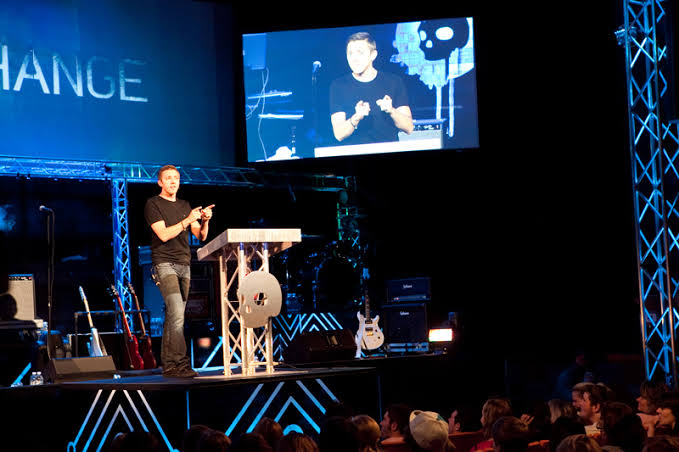
Skull Church is an evangelistic outreach event created by pastor Levi Lusko as an offshoot of Fresh Life Church, the multi-site congregation he and his wife, Jennie, planted in Kalispell, Montana, in 2007.
Built around a metallic pulpit shaped like a skull and a lineup that blends live Christian rock music with a straightforward gospel message, Skull Church was designed to reach young people and unchurched skeptics who would never walk into a traditional Sunday service.
Since its earliest gatherings in a downtown Montana theater, it has grown into one of Fresh Life’s signature evangelism tools, traveling to cities across the American West.
Church History
Founding and the Story Behind the Name
Skull Church grew directly out of the early years of Fresh Life Church, which Levi Lusko and his wife, Jennie, started with just 14 people in Kalispell, Montana, in 2007.
Lusko wanted a way to reach young adults who saw the skull, a symbol already stamped on board shorts, skate decks, and stickers around town, as nothing more than pop culture.
He built an entire evangelistic platform around reclaiming that image for its original biblical meaning.
The name comes from Golgotha, the Aramaic word for “the Place of the Skull,” identified in the Gospels as the hill outside Jerusalem where Jesus was crucified.
Lusko has said the name is deliberately provocative. People hear “Skull Church” and assume it sounds like a cult before they ever walk through the door, which he has openly acknowledged is part of the point: it gets their attention long enough to hear the actual message.
Early Growth
The earliest Skull Church gatherings outgrew their original meeting space and moved into the Strand Theater in downtown Kalispell, then later into the Liberty Theater, another historic venue in the same small city.
A 2010 service at the Strand Theater drew about 400 people in person, with the message simulcast to an overflow crowd at the Liberty Theater and streamed to viewers online.
Weeknight Skull Church services regularly outpaced what organizers expected from a young, unchurched Montana crowd.
Leadership
Levi Lusko founded and continues to lead Skull Church as an extension of his role as founding pastor of Fresh Life Church.
Jennie Lusko, his wife and Fresh Life’s co-pastor, has supported the outreach’s growth alongside him, and the event has drawn direct encouragement from evangelist Greg Laurie, a mentor to Lusko and an early advocate for Fresh Life Church who later invited Lusko to host his Harvest America crusade events.
Beliefs and Doctrine
Skull Church carries the same theology as its parent congregation. Fresh Life Church holds to conservative evangelical doctrine and draws heavily from the Calvary Chapel tradition Lusko grew up in as the son of an assistant pastor under Skip Heitzig at Calvary of Albuquerque.
That tradition traces back to Chuck Smith and the original Calvary Chapel movement of the 1960s and 1970s, known for verse-by-verse Bible teaching and a low-barrier, come-as-you-are approach to church culture.
Skull Church’s teaching style follows that same expository pattern, working through books of the Bible with practical application rather than relying on abstract theology.
Every gathering ends with a clear invitation to accept Christ, making evangelism, not just teaching, the event’s central purpose.
Worship and Church Life
A typical Skull Church night blends live music from touring Christian rock and worship acts with a message from Lusko delivered behind the event’s trademark skull-shaped metal pulpit, complete with a built-in screen that let him respond to text-message questions from the crowd in real time during the event’s early years.
Bands that have played Skull Church dates include Thousand Foot Krutch, The Afters, and the Robby Seay Band.
Lusko’s preaching style leans on plain, culturally current language rather than churchy vocabulary, translating biblical concepts like repentance into terms a room full of 20-somethings in flannel and skate shoes could immediately picture.
Every service closes with an altar call, and attendees who respond are invited to walk to the front of the room to pray with Lusko and his team.
Ministries and Outreach
Skull Church functions as Fresh Life Church’s primary large-scale evangelism vehicle, distinct from its regular Sunday services and its youth-focused O2 Experience, an earlier outreach Lusko launched in 2004 built around gospel readings and high-energy worship for younger audiences.
Where O2 targets students, Skull Church was built with a broader, older, more skeptical crowd in mind, people who might never set foot inside a traditional church building.
The event has traveled well beyond its original Kalispell home, holding weekend dates in cities including Billings and Missoula, Montana, bringing the same music-and-message format to communities across Fresh Life’s growing footprint in the American West.
Media and Resources
Skull Church services have been broadcast live online since their earliest years in Kalispell, archived afterward as podcasts and posted to YouTube for anyone who missed the original stream.
That media-first approach mirrors Fresh Life Church’s broader use of radio, television, and online broadcasting to extend its reach across Montana, Idaho, Oregon, Utah, and Wyoming.
Impact and Influence
Skull Church became one of the defining stories of Fresh Life Church’s early growth, helping turn a 14-person church plant into a congregation that draws roughly 15,000 people weekly across its campuses today, with a much larger online audience.
The event’s willingness to use an unconventional, even confrontational name to get a foot in the door with unchurched audiences became something of a template for Lusko’s broader ministry philosophy: use the language and symbols people already recognize to introduce them to a message they haven’t actually heard.
Fresh Life Church, the ministry Skull Church helped build, now operates as part of the Association of Related Churches and Craig Groeschel’s Open Network, extending its influence through church-planting partnerships well beyond the events Lusko started hosting in a small Montana theater.
Facilities and Venues
Skull Church has never had a permanent building of its own. Its earliest home was the historic Strand Theater in downtown Kalispell, later expanding overflow crowds into the nearby Liberty Theater.
As the event grew into a touring outreach, it moved into larger venues in other Montana cities, including the Babcock Theatre in Billings, reflecting its identity as a traveling event rather than a fixed congregation.
Criticism and Controversies
Skull Church’s name and imagery have drawn skepticism, largely from people encountering the event for the first time.
Lusko has said directly that many first-time attendees assume “Skull Church” sounds like a cult before they understand the biblical reference behind the name.
Some more traditional Christian observers have also questioned Lusko’s broader visual style, including his tattoos and the skull-branded pulpit itself, as an unusual look for an evangelical pastor.
Lusko has never apologized for either choice, framing both as tools to reach people who would otherwise dismiss a more conventional-looking church outright.
Financial Information
Skull Church operates as a ministry program under Fresh Life Church rather than as a separately incorporated organization, so it does not file its own independent nonprofit financial disclosures.
Fresh Life Church itself operates as a registered nonprofit religious organization, and no reliable, independently verified financial figures specific to Skull Church as a standalone event are publicly available.
Interesting Facts About Skull Church
- The name comes from Golgotha, the Aramaic term for “the Place of the Skull,” identified in the Gospels as the site of Christ’s crucifixion, not from anything related to death imagery for its own sake
- Its original pulpit was a metal skull-shaped structure with a built-in screen that let Lusko take live text-message questions during services
- Touring acts that have played Skull Church dates include Thousand Foot Krutch, The Afters, and the Robby Seay Band
- Early Skull Church crowds skewed heavily toward 20-somethings who described themselves as previously unchurched or skeptical of organized religion
- The event helped launch Fresh Life Church’s identity as one of the more unconventional, technology-forward evangelical churches in the American West
Timeline of Key Events
- 2007: Levi and Jennie Lusko found Fresh Life Church in Kalispell, Montana, with 14 people at the first gathering
- Early Fresh Life years: Lusko launches Skull Church as a dedicated evangelistic outreach event
- 2010: A Wednesday night Skull Church service at the Strand Theater draws about 400 people, with overflow crowds simulcast to the Liberty Theater
- 2013: Skull Church holds weekend dates in Billings, Montana, featuring Thousand Foot Krutch and The Afters
- 2026: Fresh Life Church, the ministry Skull Church helped build, reports roughly 15,000 weekly attendees across campuses in five states
Frequently Asked Questions
What is Skull Church?
Skull Church is an evangelistic outreach event created by pastor Levi Lusko as part of Fresh Life Church in Kalispell, Montana.
It combines live Christian rock music with a straightforward gospel message, aimed at reaching young people and skeptics who wouldn’t normally attend a traditional church service.
Who founded Skull Church?
Levi Lusko founded Skull Church in the early years after he and his wife, Jennie, planted Fresh Life Church in 2007.
Why is it called Skull Church?
The name comes from Golgotha, meaning “the Place of the Skull” in Aramaic, the site identified in the Gospels where Jesus was crucified.
Lusko chose the name deliberately, using an image already familiar from pop culture to draw in people who would never consider attending a church with a more conventional name.
Where is Skull Church located?
Skull Church began at the Strand Theater in downtown Kalispell, Montana, and has since held events in other Montana cities, including Billings and Missoula, as part of Fresh Life Church’s broader outreach.
Is Skull Church the same as the Bone Church or Skull Chapel in Europe?
No. Skull Church has no connection to the historic ossuaries in Europe sometimes called “bone churches” or “skull chapels,” such as the Sedlec Ossuary in the Czech Republic or the Skull Chapel in Czermna, Poland.
Those are centuries-old burial sites decorated with human bones, an entirely different kind of landmark with a different history.
Searches for “Bone Church,” “Skull Chapel,” or their locations in Prague, Poland, Portugal, Italy, or elsewhere refer to those historic ossuaries, not to Levi Lusko’s ministry, and would make a strong subject for a separate travel or church-history article rather than a section here.
Final Word
Skull Church took a symbol most churches would run from and turned it into an open door, betting that a provocative name would earn Levi Lusko a hearing with people who had already written off church altogether.
That bet helped build Fresh Life Church into a congregation spanning five states, proof that an unconventional entry point can still lead somewhere very traditional: an altar call and an invitation to faith.