



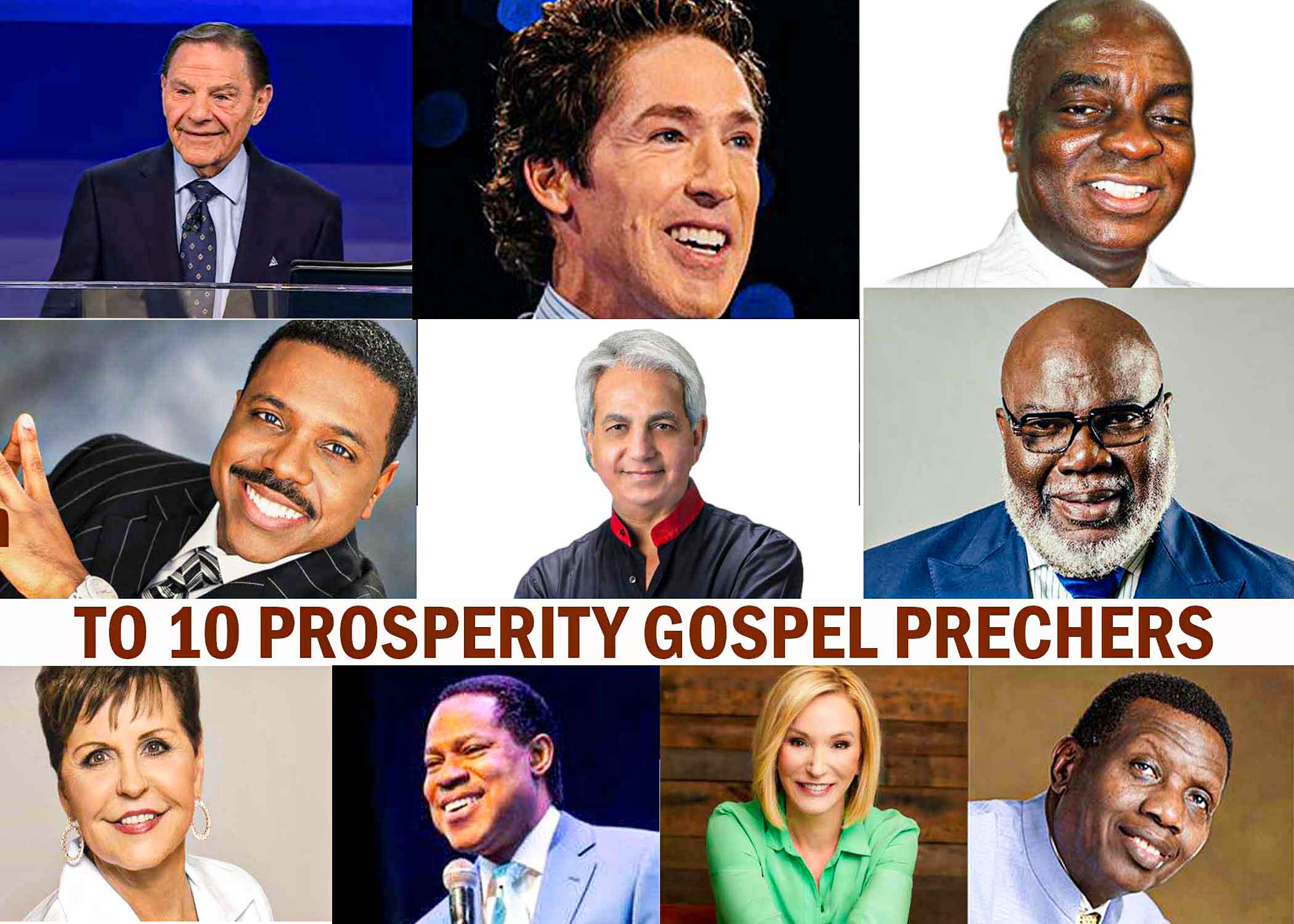
You’ve probably heard someone shout “Name it and claim it!” in church. Or watched a televangelist hold up a prayer cloth on late-night TV while asking for a seed offering.
That’s the prosperity gospel in action, and it has shaped modern Christianity more than almost any other teaching of the past century.
The prosperity gospel — also called the Word of Faith movement, health and wealth gospel, or seed-faith theology — teaches that God wants believers to prosper financially and physically.
Faith, positive confession, and generous giving, its teachers say, are the keys that unlock those blessings. Critics call it a distortion of Scripture.
Supporters call it hope in action. Either way, the preachers who carry this message have built some of the biggest religious empires on earth.
This list covers the top 10 prosperity gospel preachers whose reach, influence, and controversy have defined the movement, from its American founders to its African powerhouses.
We’ll cover who they are, what they teach, what they’ve built, and what critics say.
What Is the Prosperity Gospel?
Before the names, a quick grounding. The prosperity gospel is not one single denomination. It cuts across Pentecostal, Charismatic, and non-denominational Christianity. At its core, it makes four main claims:
- God wants all believers to be healthy and wealthy.
- Faith, when spoken aloud as positive confession, releases divine provision.
- Giving — especially to the church or ministry — is a seed that returns multiplied.
- Sickness and poverty are signs of insufficient faith or sin.
The movement traces its roots to the early 20th century, gaining momentum through preachers like E.W. Kenyon, who coined the phrase “What I confess, I possess,” and Oral Roberts, who introduced “seed-faith” giving in the 1950s.
From there, it spread through television, megachurches, and eventually the internet — reaching billions in Africa, Latin America, and Asia.
Scholars like Kate Bowler, author of Blessed: A History of the American Prosperity Gospel, trace this movement carefully. She notes that the prosperity gospel has become one of the most significant — and most debated — religious forces of our time.
Top 10 Prosperity Gospel Preachers in the World
1. Kenneth Copeland
| Full Name | Kenneth Max Copeland |
|---|---|
| Born | December 6, 1936 — Lubbock, Texas, USA |
| Age | 89 (as of 2026) |
| Nationality | American |
| Ministry | Kenneth Copeland Ministries (KCM) |
| Church | Eagle Mountain International Church, Fort Worth, Texas |
| Denomination | Word of Faith (Charismatic) |
| Est. Net Worth | ~$300–$400 million |
| TV Program | Believer’s Voice of Victory |
Kenneth Copeland is widely considered the most influential prosperity gospel preacher alive today — and, by most estimates, the wealthiest pastor in the world.
He built Kenneth Copeland Ministries from the ground up in the 1960s, drawing heavily on the teachings of Kenneth E. Hagin, whose “rhema” theology of spoken faith became the backbone of the entire Word of Faith movement.
Before ministry, Copeland had a brief music career. His 1957 recording of “Pledge of Love” reached the Top 40. He later became Oral Roberts’ personal pilot before launching his own ministry.
That aviation background never left him — today, Copeland’s ministry owns multiple private jets, a detail that drew intense public scrutiny when he defended the purchases on Christian television in 2019.
His Believer’s Voice of Victory television program reaches millions globally. His annual Southwest Believers’ Convention draws tens of thousands to Fort Worth. His 1,500-acre campus near Fort Worth includes a private airstrip, a church, and a ministry-owned home valued in the millions.
Copeland teaches that believers are “little gods” with authority over spiritual and material reality. Positive confession — declaring what you believe before you see it, is central to his message.
Critics, including mainstream evangelical theologians, say this teaching misreads Scripture and gives believers false expectations. Supporters say it has transformed their finances and faith.
Key controversies: Senate Finance Committee investigation (2007–2011) into ministry finances; defending private jet ownership on live television; COVID-19 remarks in 2020 that drew widespread mockery.
2. Joel Osteen
| Full Name | Joel Scott Osteen |
|---|---|
| Born | March 5, 1963 — Houston, Texas, USA |
| Age | 63 (as of 2026) |
| Nationality | American |
| Church | Lakewood Church, Houston, Texas |
| Denomination | Non-denominational (Charismatic) |
| Weekly Attendance | ~52,000 |
| TV Reach | ~10 million viewers weekly |
| Est. Net Worth | ~$100 million |
Joel Osteen is the most recognized face of the prosperity gospel in mainstream American culture. He is the senior pastor of Lakewood Church in Houston — the largest congregation in the United States, meeting in a former NBA arena that seats 16,000 people.
His weekly services attract roughly 52,000 attendees, and his television broadcasts reach an estimated 10 million viewers per week across more than 100 countries.
He took the pulpit in 1999 after the sudden death of his father, John Osteen, who founded Lakewood in 1959. Joel had never preached publicly before. Within two years, attendance doubled. Within a decade, Lakewood became a household name.
His 2004 book Your Best Life Now spent more than 200 weeks on the New York Times bestseller list. He has since published more than 20 books, with combined sales exceeding 10 million copies.
He stopped taking a pastoral salary in 2005, choosing to live off book royalties instead.
Osteen’s preaching style differs from the harder-edged Word of Faith preachers. He rarely mentions sin, hell, or repentance. His message is warm, motivational, and relentlessly positive — some call it the prosperity gospel with a smile.
Critics, including theologians like John MacArthur, say he preaches a gospel of self-help, not salvation. His defenders say he meets people where they are.
Key controversy: During Hurricane Harvey in 2017, Osteen initially delayed opening Lakewood Church as a shelter — drawing national criticism before reversing course and housing thousands.
3. David Oyedepo
| Full Name | David Olaniyi Oyedepo |
|---|---|
| Born | September 27, 1954 — Osogbo, Osun State, Nigeria |
| Age | 71 (as of 2026) |
| Nationality | Nigerian |
| Church | Living Faith Church Worldwide (Winners’ Chapel) |
| Headquarters | Faith Tabernacle, Ota, Ogun State, Nigeria |
| Denomination | Pentecostal / Word of Faith |
| Est. Net Worth | ~$150–$200 million |
Bishop David Oyedepo is Africa’s most prominent prosperity gospel preacher and one of the wealthiest pastors in the world. He founded Living Faith Church Worldwide — popularly known as Winners’ Chapel — in 1981, and his Living Faith Church has grown into one of the most expansive religious organizations on the African continent.
His flagship auditorium, Faith Tabernacle in Ota, Nigeria, seats 50,000 worshippers and held the record for the world’s largest church building for many years. Winners’ Chapel now has branches in more than 300 cities across Africa, Europe, and North America.
Oyedepo is not just a preacher — he is a builder. He founded Covenant University in Ota, one of Nigeria’s top-ranked private universities. His Faith Academy network of schools educates thousands of children. His publishing house, Dominion Publishing House, has produced dozens of books on faith, success, and prosperity theology.
His theology is firmly in the Word of Faith tradition. He teaches that divine covenants guarantee health, wealth, and success to the faithful. He also holds four private jets — a detail that critics, including the Nigerian Senate, have publicly questioned.
For more on his life, ministry, and legacy, read the full biography Bishop David Oyedepo.
4. Creflo Dollar
| Full Name | Creflo Augustus Dollar Jr. |
|---|---|
| Born | January 28, 1962 — College Park, Georgia, USA |
| Age | 64 (as of 2026) |
| Nationality | American |
| Church | World Changers Church International (WCCI), College Park, Georgia |
| Denomination | Non-denominational (Word of Faith) |
| Founded | 1986 (started with 8 members) |
| Est. Net Worth | ~$27–$30 million |
Creflo Dollar started his church with eight people in a cafeteria in 1986. Today, World Changers Church International in College Park, Georgia — a suburb of Atlanta — has tens of thousands of members and satellite locations worldwide. That growth is a story Dollar tells often. To him, it is proof that his message works.
Dollar’s prosperity gospel is blunt and direct. He teaches that God wants believers to be wealthy, that tithing unlocks financial blessing, and that Christians who give generously will receive multiplied returns.
He is known for holding up checks from congregation members who claim their giving led to financial breakthroughs.
His ministry draws viewers through Changing Your World, his television program that airs on major Christian networks and reaches a global audience. He has written books including 8 Steps to Create the Life You Want (2008).
Key controversies: In 2013, Dollar asked his congregation to donate $65 million toward a private jet for the ministry — a request that made international news and sparked intense public backlash. A 2012 domestic dispute involving his daughter also drew significant media attention.
In recent years, Dollar publicly walked back some of his stronger prosperity claims, stating in a 2019 sermon that tithing does not guarantee financial return in the way he had previously taught. That admission surprised and divided his followers.
5. Benny Hinn
| Full Name | Toufik Benedictus Hinn |
|---|---|
| Born | December 3, 1952 — Jaffa, Israel |
| Age | 73 (as of 2026) |
| Nationality | Israeli-American |
| Ministry | Benny Hinn Ministries |
| TV Program | This Is Your Day |
| Denomination | Charismatic / Non-denominational |
| Est. Net Worth | ~$60 million |
Benny Hinn is one of the most theatrical and polarizing figures in Charismatic Christianity. Born in Jaffa, Israel, to a Greek father and Armenian mother, Hinn immigrated to Canada as a teenager.
He says a divine encounter in 1972 transformed him from a shy, stuttering young man into a preacher with the power to heal.
His This Is Your Day television program has aired for decades and remains one of the most-watched Christian programs on earth. His healing crusades — held in stadiums across Africa, Asia, Latin America, and Europe — draw hundreds of thousands of attendees.
At these events, Hinn prays for the sick, and people are said to fall “slain in the Spirit,” with many claiming miraculous healings.
Hinn’s 1990 book Good Morning, Holy Spirit sold millions of copies and remains one of the bestselling Charismatic books of all time. His message centers on divine healing, anointing, and the power of the Holy Spirit — often tied to financial giving as a prerequisite for breakthrough.
Key controversies: The U.S. Senate Finance Committee investigated Hinn’s ministry finances in 2007. Multiple investigative reports have questioned healing claims made at his crusades.
In a 2019 video that went viral, Hinn publicly stated that he had “gone too far” with prosperity gospel teachings — particularly the idea that giving money leads to financial reward — calling it “an offense to the Holy Spirit.”
6. T.D. Jakes
| Full Name | Thomas Dexter Jakes Sr. |
|---|---|
| Born | June 9, 1957 — South Charleston, West Virginia, USA |
| Age | 69 (as of 2026) |
| Nationality | American |
| Church | The Potter’s House, Dallas, Texas |
| Denomination | Non-denominational (Pentecostal / Word of Faith) |
| Est. Net Worth | ~$147–$150 million |
T.D. Jakes sits at the intersection of the prosperity gospel, Black church tradition, and Hollywood. He is the bishop and founder of The Potter’s House in Dallas, Texas — one of America’s largest congregations, with over 30,000 members.
Jakes is not a pure Word of Faith preacher in the Copeland mold. He blends prosperity themes with deep emotional preaching on trauma, grief, identity, and purpose.
His 1993 breakthrough book Woman, Thou Art Loosed! addressed the pain and healing of women — and became a bestseller, a stage production, and eventually a feature film.
He has produced or co-produced multiple films through his production company, TDJ Enterprises.
The prosperity gospel thread runs through his work: he teaches that God’s blessing covers every area of life — emotional, physical, relational, and financial. He has hosted the annual MegaFest conference, which drew over 300,000 people to Dallas in its peak years.
Key controversy: In late 2023, Jakes became the subject of serious public allegations tied to a broader controversy involving Sean “Diddy” Combs. Jakes denied all claims, and no charges were filed against him. The allegations, however, circulated widely on social media and created significant reputational damage during 2023–2024.
7. Joyce Meyer
| Full Name | Pauline Joyce Meyer |
|---|---|
| Born | June 4, 1943 — St. Louis, Missouri, USA |
| Age | 83 (as of 2026) |
| Nationality | American |
| Ministry | Joyce Meyer Ministries |
| TV Program | Enjoying Everyday Life |
| Denomination | Non-denominational (Charismatic) |
| Est. Net Worth | ~$8 million (personal); ministry revenue ~$160 million annually |
Joyce Meyer is one of the most recognizable female voices in Christian media worldwide. She is the founder of Joyce Meyer Ministries, based in Fenton, Missouri, and the host of Enjoying Everyday Life — a daily television and radio program that reaches hundreds of millions of people in more than 100 languages.
Meyer’s background sets her apart. She grew up in a dysfunctional home, experiencing childhood abuse that left deep wounds. She came to faith as an adult and began teaching a small home Bible study in the 1970s.
That small group eventually became a global ministry. Her story of overcoming trauma through faith is central to her brand — and it gives her message a credibility that pure prosperity preachers sometimes lack.
Her approach to the prosperity gospel is more personal and practical than theological. She teaches that God wants you to enjoy your life, manage your emotions, and overcome mental strongholds — and that financial blessing follows obedience and right thinking.
Her books on emotional health, anger management, and joy have sold tens of millions of copies globally.
While Meyer personally lives modestly relative to her peers on this list, a 2009 news investigation revealed that Joyce Meyer Ministries had spent substantial funds on homes for its leaders, expensive office furnishings, and executive travel — prompting governance questions the ministry subsequently addressed.
8. Chris Oyakhilome
| Full Name | Chris Oyakhilome |
|---|---|
| Born | December 7, 1963 — Edo State, Nigeria |
| Age | 62 (as of 2026) |
| Nationality | Nigerian |
| Church | Christ Embassy (Believers’ LoveWorld Incorporated) |
| HQ | Lagos, Nigeria (with major hubs in London and Toronto) |
| Denomination | Pentecostal / Word of Faith |
| Est. Net Worth | ~$50–$110 million |
Pastor Chris Oyakhilome is one of Africa’s most globally connected prosperity gospel preachers. He founded Christ Embassy — officially called Believers’ LoveWorld Incorporated — while still a university student in Benin City, Nigeria, in the 1980s. The church now has millions of members across 140 countries.
He is the creator of Loveworld TV, a satellite television network that broadcasts his ministry 24 hours a day across Africa, Europe, and North America.
His Rhapsody of Realities daily devotional, co-authored with his former wife Anita, is published in more than 800 languages and dialects — a record that the organization has cited as one of the world’s most translated and distributed books.
Oyakhilome’s theology is steeped in Word of Faith teaching. He emphasizes healing, divine health, and the supernatural power available to believers. His large “Healing School” events draw thousands seeking physical miracles.
Key controversy: In 2020, Oyakhilome drew significant backlash for claiming on video that 5G technology was connected to the COVID-19 pandemic — a claim with no scientific basis. UK communications regulator Ofcom penalized Loveworld TV’s UK broadcast license for airing the content.
9. Paula White-Cain
| Full Name | Paula Michelle White-Cain |
|---|---|
| Born | April 20, 1966 — Tupelo, Mississippi, USA |
| Age | 60 (as of 2026) |
| Nationality | American |
| Church | New Destiny Christian Center, Apopka, Florida |
| Denomination | Non-denominational (Charismatic / Word of Faith) |
| Political Role | Special Adviser to U.S. President Donald Trump (2017–2021) |
| Est. Net Worth | ~$5 million |
Paula White-Cain is the only prosperity gospel preacher on this list who has held a formal role in the U.S. government. She served as a Special Adviser to President Donald Trump on faith-based and community initiatives from 2017 to 2021 — giving her an unusual platform at the intersection of church and state.
White grew up in a difficult home, experiencing childhood trauma that she describes openly as part of her testimony. She came to faith as a teenager and began preaching in her twenties.
She built her ministry through television, initially co-leading Without Walls International Church in Tampa, Florida, with her then-husband Randy White. After their divorce, she moved to New Destiny Christian Center in the Orlando area.
Her prosperity gospel is straightforward: God rewards the faithful with material blessings, and giving to ministry is a form of spiritual seed-planting that returns harvest.
She has sold millions of dollars in “first-fruits” offerings — asking supporters to give their first month’s salary of each year to her ministry. That practice, in particular, has attracted serious theological and ethical criticism from within the evangelical world.
She also officiated at Trump’s 2017 inauguration prayer — making her one of the most politically visible religious figures of the decade.
10. Enoch Adeboye
| Full Name | Enoch Adejare Adeboye |
|---|---|
| Born | March 2, 1942 — Ifewara, Osun State, Nigeria |
| Age | 84 (as of 2026) |
| Nationality | Nigerian |
| Church | Redeemed Christian Church of God (RCCG) |
| HQ | Redemption City, Ogun State, Nigeria |
| Denomination | Pentecostal |
| RCCG Branches | 200+ countries |
Pastor Enoch Adeboye is a different kind of prosperity gospel preacher. He holds a PhD in mathematics from the University of Lagos.
He was a university lecturer before becoming the General Overseer of the Redeemed Christian Church of God (RCCG) in 1981 — a church that has since grown into one of the largest denominations in the world, with branches in more than 200 countries.
The RCCG’s Redemption Camp — a purpose-built ministry city along the Lagos-Ibadan Expressway — hosts the monthly Holy Ghost Night services and the annual Holy Ghost Congress, which routinely draws millions of worshippers to a single outdoor location. These are among the largest religious gatherings on earth.
Adeboye does not preach the harder version of Word of Faith theology. He does not typically promise jets for seed offerings. But his message carries clear prosperity themes: he teaches that God’s covenant guarantees provision, promotion, and protection to the faithful, and that consistent giving and prayer are keys to divine favor. He has acknowledged the prosperity gospel label, saying Pentecostals “talk of the here and now, not just the by and by.”
He was named one of Time magazine’s 100 Most Influential People in the World in 2008. For his full story, read the Enoch Adeboye biography.
Honorable Mentions: Other Major Prosperity Gospel Preachers
This list could easily run to 25 names. Here are five more who deserve recognition:
- Kenneth E. Hagin (1917–2003) — Often called the father of the modern Word of Faith movement. His rhema theology and Rhema Bible Training College trained a generation of prosperity preachers, including Kenneth Copeland.
- Oral Roberts (1918–2009) — The original mass-media prosperity evangelist. His “seed-faith” concept — give to God, expect a miracle return — laid the foundation for everything that followed.
- Jesse Duplantis (born 1949) — Louisiana-based televangelist known for claiming divine trips to heaven and for famously asking his congregation to fund a fourth private jet in 2018.
- Joseph Prince (born 1963) — Singapore-based pastor of New Creation Church, one of the world’s largest congregations. His “Hyper-Grace” theology blends prosperity with an emphasis on unearned, unconditional divine favor.
- David Ibiyeomie (born 1961) — Nigerian pastor and founder of Salvation Ministries in Port Harcourt. One of Nigeria’s fastest-growing prosperity preachers, with a style heavily influenced by David Ibiyeomie’s Word of Faith roots.
What Does the Bible Actually Say About Prosperity?
This is the question at the heart of every debate about these preachers. Does God promise material wealth to the faithful?
Prosperity gospel preachers lean heavily on passages like 3 John 1:2 (“Beloved, I wish above all things that thou mayest prosper and be in health”), Deuteronomy 28 (blessings for obedience), and John 10:10 (“I am come that they might have life, and that they might have it more abundantly”).
Critics respond with equally clear passages. Jesus told the rich young ruler to sell everything (Matthew 19:21). Paul wrote that godliness with contentment is great gain — not godliness plus a Cadillac (1 Timothy 6:6). Hebrews 11 — the “Hall of Faith” — praises believers who wandered homeless, were tortured, and died as strangers on the earth. Not exactly a prosperity narrative.
Most mainstream evangelical and Reformed theologians say the prosperity gospel confuses Old Covenant material promises with the New Covenant reality that suffering, not comfort, is often the path of faithful discipleship. The Lausanne Theology Working Group has formally identified the prosperity gospel as a significant theological error — one that particularly exploits vulnerable people in the Global South.
Supporters say the critics miss the point: they’re not promising Ferrari-level wealth. They’re offering hope to people who have none. And for millions of followers in Africa, Asia, and Latin America, that hope is real and transformative.
Why Is the Prosperity Gospel So Popular in Africa?
The prosperity gospel has found its most fertile ground in sub-Saharan Africa. Countries like Nigeria, Ghana, Zimbabwe, and Kenya have produced some of the movement’s largest churches and most dynamic preachers. The reasons are layered.
First, the message meets a real need. In economies where unemployment is high, where corruption limits opportunity, and where healthcare is inaccessible for millions, the promise that God can change your circumstances is extraordinarily powerful. Prosperity theology offers divine agency in situations where human agency feels impossible.
Second, the theology connects with African spiritual worldviews that already assume a direct link between spiritual action and material outcome. Giving, blessing, and divine favor are concepts that resonate culturally in ways they may not in secular Western settings.
Third, American televangelism exported the model — cassette tapes, then satellite TV, then social media — building a template that African preachers adopted, adapted, and often exceeded. Churches like Oyedepo’s Winners’ Chapel and Adeboye’s RCCG are now larger than almost anything in the United States.
Criticism and Controversy: The Honest Conversation
Prosperity gospel preachers face consistent criticism from multiple directions.
Theological critics argue that the movement misreads Scripture, creates false expectations, and places the burden of unanswered prayer on the shoulders of the sick and poor — implying their suffering is their own fault for lacking faith.
Financial critics point to the Senate Finance Committee’s 2007 investigation into six major televangelists — including Creflo Dollar, Benny Hinn, Joyce Meyer, and Kenneth Copeland — for potential violations of their tax-exempt status. Most cooperated partially; some refused outright.
Former followers have spoken out about feeling manipulated by seed-faith offerings that promised financial miracles that never came. Some gave money they could not afford, expecting a divine return that never arrived.
At the same time, millions of people worldwide credit these ministries with saving their marriages, transforming their finances, and giving them hope in desperate seasons. The testimonies are real, even if the theology is contested.
Frequently Asked Questions About Prosperity Gospel Preachers
Who started the prosperity gospel?
The modern prosperity gospel movement began in the 1950s with Oral Roberts, who introduced the concept of “seed-faith” giving. Before him, E.W. Kenyon (1867-1948) developed the idea that spoken confession of faith produces material reality.
Kenneth E. Hagin built on both men’s work in the 1960s-70s to create what became the Word of Faith movement — the direct theological parent of most prosperity gospel preachers today.
What is the difference between prosperity gospel and Word of Faith?
They are closely related but not identical. The Word of Faith movement focuses specifically on the power of spoken confession — declaring what you believe aloud to bring it into existence.
The prosperity gospel is broader, covering any teaching that links faith, giving, or obedience to material reward. Most Word of Faith preachers also preach prosperity, but not all prosperity preachers use classic Word of Faith confession techniques.
Is the prosperity gospel biblical?
This is one of the most debated questions in modern Christianity. Prosperity gospel preachers say yes, citing Old Testament covenant promises and Jesus’ statement that he came to give “abundant life.”
The majority of mainstream evangelical, Reformed, and Catholic theologians say no — that the movement misapplies Scripture, ignores the cross, and contradicts the consistent New Testament theme that suffering and self-denial are central to Christian discipleship.
How rich are prosperity gospel preachers?
Kenneth Copeland leads with an estimated net worth of $300–$400 million. David Oyedepo is estimated at $150–$200 million. T.D. Jakes and Benny Hinn are often cited at $60–$150 million.
Joel Osteen is estimated at around $100 million, though he derives most of his wealth from book sales rather than ministry salary.
Has any prosperity gospel preacher renounced the message?
Yes. Benny Hinn made public statements in 2019 saying he had gone too far with prosperity gospel teachings, calling the seed-faith-for-financial-return model “an offense to the Holy Spirit.”
Creflo Dollar similarly walked back some of his tithing-as-guarantee claims in 2019. Neither fully abandoned prosperity theology — but both made significant public corrections.
Timeline: Key Moments in the Prosperity Gospel Movement
- 1950s — Oral Roberts introduces seed-faith giving and launches one of America’s first televangelist empires.
- 1962 — Kenneth E. Hagin founds Rhema Bible Training College, training a generation of Word of Faith preachers.
- 1967 — Kenneth Copeland launches Kenneth Copeland Ministries in Fort Worth, Texas.
- 1973 — Trinity Broadcasting Network (TBN) is founded, giving prosperity gospel preachers a 24/7 television platform.
- 1981 — David Oyedepo founds Living Faith Church in Nigeria; Enoch Adeboye becomes RCCG General Overseer.
- 1990 — Benny Hinn publishes Good Morning, Holy Spirit, which sells millions globally.
- 1999 — Joel Osteen takes the Lakewood pulpit following his father’s death.
- 2004 — Joel Osteen publishes Your Best Life Now, making prosperity gospel mainstream.
- 2007 — U.S. Senate Finance Committee opens investigations into six prosperity gospel ministries.
- 2008 — Enoch Adeboye named one of Time‘s 100 Most Influential People in the World.
- 2019 — Benny Hinn and Creflo Dollar both publicly walk back some prosperity gospel claims.
- 2020 — COVID-19 exposes fault lines: several prosperity preachers face criticism for their responses to a global health crisis.
Final Thought: A Movement That Won’t Go Away
The prosperity gospel is the most controversial movement in modern Christianity. Theologians argue about it. Governments investigate it. Former followers warn against it.
And yet — hundreds of millions of people around the world keep coming back to its churches, watching its television programs, and buying its books.
That tells you something. Not necessarily that the theology is right, but that the need it speaks to is real. People want to believe God is good, that he sees their struggle, and that things can get better.
Those are not wrong desires. The question is always whether the message being offered actually leads people to Jesus — or leads them to a version of Jesus who exists primarily to make them rich.
That is a question every believer should wrestle with honestly. And the preachers on this list — whatever you think of their theology — have made that question impossible to avoid.
Want to go deeper on any of these figures? Explore our full pastor biography collection on Flicxa, where we cover the life, ministry, and legacy of Christian leaders from around the world.
Read Also
- Bishop David Oyedepo: Biography, Family, Net Worth, and the Rise of Winners’ Chapel
- Dr. Paul Enenche: Biography, Age, Wife, Children, Songs, Church & Net Worth
- Joshua Iginla Biography: Age, Spiritual Father, Wife, Church & Prophecy Story
- Paul Adefarasin Biography: Age, Wife, Children, Family & House on the Rock Ministry
- David Ibiyeomie Biography