



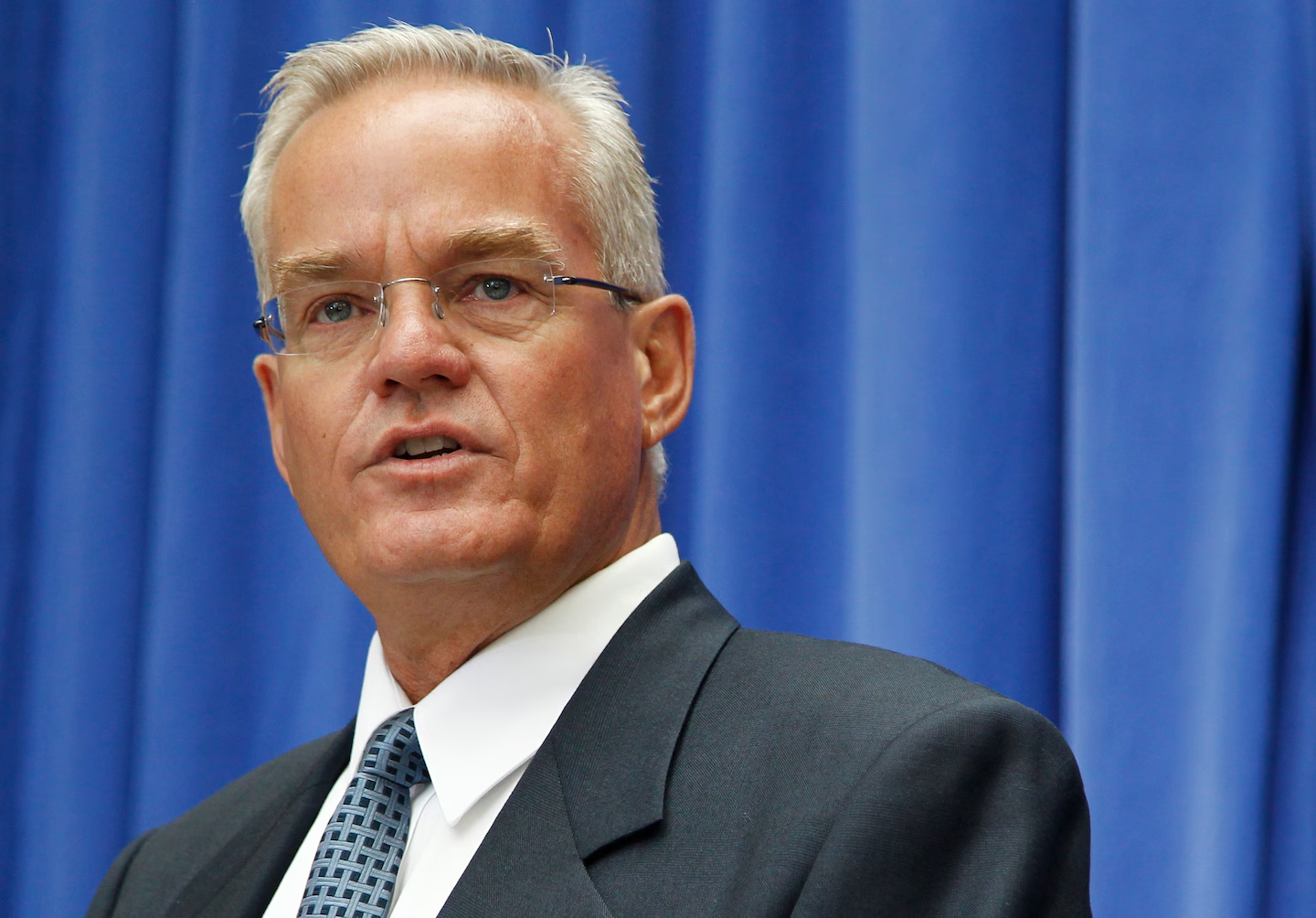
William “Bill” Hybels (born December 12, 1951, in Kalamazoo, Michigan) is an American pastor, author, and church leader best known as the founding pastor of Willow Creek Community Church in South Barrington, Illinois.
Over more than four decades, Hybels built Willow Creek from a rented movie theater with a handful of young people into one of the largest and most influential churches in North America, regularly drawing more than 25,000 attendees across eight campuses.
He also founded the Willow Creek Association (now the Global Leadership Network) and created the Global Leadership Summit, an annual leadership event that reached hundreds of thousands of pastors and leaders in more than 130 countries.
Hybels is the bestselling author of more than 20 books on leadership, prayer, and Christian living. He resigned from Willow Creek in April 2018 following allegations of sexual misconduct, which an independent review later found to be credible. As of 2026, Bill Hybels is 74 years old and alive.
Bill Hybels at a Glance
| Category | Details |
|---|---|
| Personal | |
| Full name | William Hybels |
| Born | December 12, 1951 — Kalamazoo, Michigan, USA |
| Age | 74 (as of 2026) |
| Nationality | American |
| Ethnicity | Dutch-American |
| Spouse | Lynne Hybels (m. 1974) |
| Children | Shauna Niequist (daughter); Todd Hybels (son) |
| Parents | Vernon Hybels (father); Gertrude “Jerry” Hybels (mother) |
| Education | |
| Undergraduate | Bachelor’s degree in Biblical Studies, Trinity International University (formerly Trinity College), near Chicago |
| Honorary degree | Doctor of Divinity (honorary), Trinity International University |
| Ministry | |
| Title | Founding Pastor (retired) |
| Church founded | Willow Creek Community Church, South Barrington, Illinois |
| Denomination | Non-denominational (Evangelical, Charismatic-adjacent) |
| Served | 1975–2018 |
| Other organizations | Willow Creek Association (founded 1992); Global Leadership Summit (founded 1995) |
| Career | |
| Books | 20+ published titles |
| Status | Retired from public ministry since 2018 |
| Estimated net worth | ~$30 million (est.; figures vary widely across sources) |
Early Life and Background
Bill Hybels was born into a Dutch-American family in Kalamazoo, Michigan, on December 12, 1951. His father, Vernon Hybels, ran a wholesale produce company, and the work ethic Vernon modeled had a lasting effect on his son.
Growing up, the family worshipped in the Christian Reformed Church in North America, a denomination shaped by Calvinist theology and a strong community conscience.
The family expected Bill to eventually take over the produce business. He was on track to do exactly that — until a summer camp in Wisconsin as a teenager changed everything.
In a 2006 interview with the Chicago Tribune, Hybels pointed to that camp experience as the moment his Christian faith stopped being inherited and became personal. He walked away from it with a clear sense of calling to ministry.
Education and the Moment Everything Shifted
Hybels enrolled at Trinity International University (then called Trinity College) near Chicago to study Biblical Studies. It was there, in the early 1970s, that a professor named Gilbert Bilezikian delivered a lecture that altered the direction of his life.
Bilezikian painted a picture of what the early church in Acts 2 looked like — a community of radical inclusion, deep relationships, and life-changing worship. Hybels was gripped. He abandoned his plans for business and threw himself into ministry.
He earned his Bachelor’s degree in Biblical Studies from Trinity International University. He later received an honorary Doctor of Divinity from the same institution. Bilezikian would go on to become a co-founder of Willow Creek.
The Birth of Son City and the Road to Willow Creek
In 1971, while still a student, Hybels began serving as youth pastor at South Park Church in Park Ridge, Illinois.
Together with a friend named Dave Holmbo, he launched a youth ministry called Son City — combining contemporary music, dramatic sketches, and Bible teaching in language that teenagers could actually understand.
The numbers were startling. Son City grew from 25 students to 1,200 in just three years. After a May 1974 service where more than 300 young people waited in line to get in, Hybels and his team began to dream bigger. What if this wasn’t just a youth group? What if it was a whole new kind of church?
Asking the Question Most Churches Never Asked
Before founding Willow Creek, Hybels and his team did something unusual for 1975: they knocked on doors in the Palatine and South Barrington area and asked residents why they didn’t go to church.
The answers they heard shaped everything that followed. People said church was boring. They said pastors made them feel guilty and ignorant. They said the church always seemed to want their money.
Those answers became the blueprint. Hybels set out to build a church that would remove every unnecessary barrier between a skeptical person and the message of Jesus.
Willow Creek Opens in a Movie Theater
On October 12, 1975, Willow Creek Community Church held its first service in a rented movie theater in Palatine, Illinois. Hybels was 23 years old.
The young congregation sold tomato plants door-to-door to fund the startup. Services featured contemporary music, drama, and preaching rooted in everyday relevance rather than traditional religious structure.
The church grew fast. Within two years it had 2,000 attendees. In 1981, Willow Creek moved to its permanent home on a 90-acre campus in South Barrington, northwest of Chicago.
By the time a new 7,000-seat Worship Center opened in 2004, the church was drawing more than 20,000 people each weekend.
Ministry and Rise to Prominence
Hybels built Willow Creek around what became known as the seeker-sensitive model. The idea was simple, even if the execution wasn’t: design Sunday services for people who don’t go to church.
No Christian jargon. No assumption of prior belief. Contemporary music, short video segments, topical preaching tied to real life.
Then build a second, deeper track — “New Community” midweek services — for those who wanted to go further in their faith.
The model attracted enormous attention. The Harvard Business Review studied Willow Creek’s organizational methods.
Business leaders flew in from across the country to understand how Hybels had built something so large, so fast. The church wasn’t just growing — it was being analyzed as a case study in leadership and organizational culture.
The Willow Creek Association and the Global Leadership Summit
In 1992, Hybels launched the Willow Creek Association (WCA) — a network connecting thousands of like-minded churches across denominations.
By its peak, the WCA linked more than 14,000 congregations across 92 denominations. Churches paid membership fees and received access to resources, training, and conferences.
In 1995, Hybels launched the Global Leadership Summit — a two-day annual event held each August and broadcast live from Willow Creek’s South Barrington campus to sites across North America and eventually 130+ countries in more than 60 languages. Speakers over the years included Condoleezza Rice, Colin Powell, Bono, Brené Brown, and Jim Collins. At its peak, the Summit reached over 400,000 leaders annually.
The Summit became one of the most significant Christian leadership gatherings on the planet. Hybels used the platform to argue that the local church was not a minor institution — it was, in his words, “the hope of the world.”
Influence on Church Models Worldwide
Willow Creek’s seeker-sensitive approach influenced thousands of churches. Pastors like Jack Hibbs and Chris Hodges — who built multi-campus megachurches of their own — emerged from a generation of leaders trained in this ministry philosophy.
The model was studied, debated, adapted, and exported globally. Even critics of the seeker-sensitive approach had to engage with Hybels’ ideas because they had become the dominant conversation in North American evangelical church growth.
Hybels also had political access few pastors have held. He served as a spiritual advisor to President Bill Clinton, and prayed with Clinton at the White House. That relationship brought both visibility and scrutiny.
Books by Bill Hybels
Hybels wrote more than 20 books across his ministry career. His writing ranged from prayer and spiritual formation to church leadership, evangelism, and personal development. Below are his most widely read titles:
| Title | Year | Focus |
|---|---|---|
| Too Busy Not to Pray | 1988 (revised 2008) | Prayer, slowing down to meet God |
| Becoming a Contagious Christian | 1994 | Evangelism and sharing faith naturally |
| Rediscovering Church (with Lynne Hybels) | 1995 | Willow Creek’s story and ministry philosophy |
| Fit to Be Tied (with Lynne Hybels) | 1997 | Marriage and making it last |
| Honest to God | 1990 | Authentic Christian living |
| Who You Are When No One’s Looking | 1987 | Character and integrity |
| The Volunteer Revolution | 2004 | Mobilizing church volunteers |
| Courageous Leadership | 2002 | Church leadership and vision |
| Just Walk Across the Room | 2006 | Simple relational evangelism |
| Holy Discontent | 2007 | Finding your ministry calling |
| Axiom: Powerful Leadership Proverbs | 2008 | Leadership principles and proverbs |
| The Power of a Whisper | 2010 | Hearing God’s voice in daily life |
| Simplify | 2014 | Uncomplifying an overloaded life |
Too Busy Not to Pray is widely regarded as Hybels’ most enduring work. First published in 1988, it has been revised twice and remains one of the best-selling Christian books on prayer of the last 40 years.
Courageous Leadership, published in 2002, became his most influential ministry text — a detailed look at what it takes to lead a church well, written after nearly three decades at the helm of Willow Creek.
J.D. Greear, a leading voice in North American evangelical leadership, represents the next generation of church leaders who built on the frameworks Hybels popularised.
Marriage and Family Life
Bill Hybels married Lynne Berry in 1974. The couple have been together since the earliest days of Willow Creek, and Lynne was a co-founder of the church in every meaningful sense. From the first services in that Palatine movie theater, she was there.
Over the years, Lynne Hybels became a recognized voice in her own right — not primarily as a pastor’s wife, but as an advocate for global justice.
She founded Ten For Congo in 2010, a fundraising initiative supporting women and girls who survived sexual violence during the civil war in the Democratic Republic of Congo.
She has traveled to conflict zones across the Middle East, Africa, and Latin America, and writes regularly on faith and justice.
Following the 2018 scandal, Lynne largely stepped back from public ministry as well. As of 2026, she remains out of the public spotlight. Her advocates note that she, too, was placed in an impossible position by the revelations about her husband.
Who Is Bill Hybels’ Daughter?
Bill and Lynne have two children: a daughter, Shauna Niequist, and a son, Todd Hybels.
Shauna Niequist is a New York Times bestselling author in her own right, known for books including Bittersweet, Present Over Perfect, and Bread and Wine.
She and her husband Aaron Niequist — who previously served as a worship leader at Willow Creek — moved from Chicago to New York City after the scandal broke in 2018.
In February 2021, Shauna posted publicly on Instagram to acknowledge her long silence on her father’s actions. She stated that her silence had wrongly communicated to many that she defended his behavior — and that she did not.
“I grieve both of those things,” she wrote, referring to her father’s actions and his ongoing silence. It was a rare public statement from within the Hybels family on the matter.
Todd Hybels has taken a significantly more private path. Little is publicly known about his current life or professional pursuits. He is three years younger than Shauna.
Ministry Philosophy and Theology
Hybels built his ministry on a conviction rooted in Acts 2: that the local church, at its best, is the most transformative force on earth.
He believed deeply that churches had driven away unchurched people through irrelevance, guilt, and poor communication — and that good leadership could change that.
His theological identity is broadly evangelical and non-denominational. He grew up in the Christian Reformed Church, a Calvinist tradition, but Willow Creek was designed from the start to sit outside denominational structures.
The church embraced a high view of Scripture, the full work of the Holy Spirit, and an emphasis on personal conversion and spiritual growth.
Hybels was also a consistent voice for leadership development. His belief that God gives spiritual gifts of leadership — and that those gifts carry serious responsibility — ran through nearly every book he wrote. Christian leadership wasn’t a platform, in his framing. It was a stewardship.
He also partnered with Dr. Henry Cloud, the author of Boundaries, on leadership development initiatives — reflecting Hybels’ long-standing interest in healthy psychology and organizational culture within ministry settings.
The Seeker-Sensitive Debate
Hybels’ model was never without its critics. Traditional and confessional churches argued that market-researched worship services substituted consumer preferences for biblical faithfulness.
Reformed critics contended that removing offense from the gospel — making services comfortable for skeptics — diluted the message itself.
Hybels himself acknowledged this tension in later years. A landmark 2007 self-study, the REVEAL survey, found that Willow Creek’s own approach had not been as effective at producing deep spiritual maturity as assumed.
Hybels called the findings “eye-opening” and said the church needed to rethink some of its core methods. It was a rare and public admission of institutional failure.
Yet the seeker-sensitive movement Hybels helped create reshaped American Christianity in ways that still hold. Thousands of churches trace their current approach — from Sunday service design to small group structures to leadership training models — back to Willow Creek’s influence. Korean megachurch pioneer David Yonggi Cho represented a parallel stream of church growth innovation outside the US; Hybels represented the defining American version.
The Misconduct Allegations and Resignation
In March 2018, the Chicago Tribune published an extensive investigation detailing allegations of sexual misconduct against Hybels spanning multiple decades.
The accusations included suggestive comments, unwanted physical contact, extended inappropriate hugs, and invitations to hotel rooms.
Several women — current and former staff members and church associates — came forward. Hybels denied the allegations, called some of them “flat-out lies,” and the church’s elder board initially cleared him following an internal review.
The situation escalated rapidly. On April 10, 2018, Hybels announced his immediate resignation from Willow Creek — six months earlier than his previously announced October retirement date.
He cited the controversy as a distraction from the church’s mission. He apologized for placing himself in “unwise situations” but stopped short of acknowledging the specific conduct alleged.
The New York Times Report and the Elder Board Collapse
In August 2018, the New York Times published an account from Pat Baranowski, who had served as Hybels’ executive assistant in the 1980s.
Baranowski alleged a prolonged pattern of sexual harassment and abuse, including groping and coerced sexual acts while she lived in the Hybels’ home and worked for him. She described years of emotional manipulation followed by more than two decades of depression, unemployment, and homelessness afterward.
The account detonated what remained of Willow Creek’s institutional stability. Lead pastor Heather Larson resigned.
Teaching pastor Steve Carter — Hybels’ named successor — said he was so disturbed by Baranowski’s account that he became physically ill before a Sunday service and resigned immediately.
Then the entire elder board resigned, publicly apologizing to the women who had come forward and acknowledging they had been wrong to defend Hybels without adequate inquiry.
“We are sorry that we added to your pain,” elder Missy Rasmussen told a stunned congregation. “We have no reason to not believe any of you.”
The Independent Investigation Findings
In February 2019, an Independent Advisory Group (IAG) commissioned to investigate the allegations released its 17-page report.
The conclusion was direct: the allegations against Bill Hybels were credible — not based on any single claim, but on the collective testimony and the weight of multiple consistent accounts spanning decades.
The IAG also found that Hybels had verbally and emotionally intimidated both male and female staff, and that the organizational culture at Willow Creek had enabled his unchecked power.
The report recommended that had Hybels still been serving as pastor, disciplinary action would have been required.
Since he had already resigned, no formal action followed. Hybels has never issued a full public apology to the women who came forward, a silence that has drawn ongoing criticism from victims, church leaders, and supporters of those affected.
What Happened to Willow Creek Church After Hybels?
The departure of Hybels and the resignation of the entire senior leadership team set off years of painful recovery at Willow Creek.
The church went through a series of interim leaders before hiring Dave Dummitt as senior pastor in June 2020. Dummitt arrived in the middle of the COVID-19 pandemic — inheriting a church already weakened by scandal and then hit by the additional blow of lockdowns and lost giving.
By 2022, the situation had become financially critical. Willow Creek announced it was eliminating roughly 30% of its staff, cutting $6.5 million in payroll costs.
Average weekly attendance had fallen from a pre-scandal peak of 25,000 to below 10,000. The church that had once drawn leaders from 130 countries was fighting for its own survival.
Willow Creek also sold several of its satellite campuses during this period as the multi-site model became unsustainable at its previous scale.
The Church’s Recovery
The recovery, though slow, eventually came. By 2024, in-person weekend attendance had climbed back to 9,875 — up 16% from the prior year — with an additional 3,700 people watching services online. The church ended 2024 with its first budget surplus since 2019.
In March 2025, Dummitt announced his own departure, and Shawn Williams — the South Barrington campus pastor — was named as the new senior pastor, effective April 1, 2025. In October 2025, Willow Creek celebrated its 50th anniversary with attendance approaching 10,000 per weekend and signs of genuine stability returning.
It is a fraction of the congregation Hybels built. But Willow Creek is still there.
Where Is Bill Hybels Now?
Since his 2018 resignation, Bill Hybels has largely disappeared from public life. He has not launched a new church. He has not returned to preaching.
He has not issued a public apology to those who came forward with allegations against him. Multiple reports indicate he has been living privately, reportedly in South Barrington, Illinois or South Carolina at various points — though no confirmed public statement addresses his current location.
He has no active YouTube channel, no public social media presence, and no known ministry activity. At the 2025 Global Leadership Summit — the annual conference he created — longtime leadership figure John Maxwell made remarks praising Hybels that drew criticism from victims’ advocates who felt the praise was inappropriate given the unresolved allegations and Hybels’ ongoing silence.
One longtime Willow Creek member, quoted in a 2025 article marking the church’s 50th anniversary, said simply: “It’s a really stark reminder that not all stories end well.”
Influence and Legacy
It is possible to hold two things at once about Bill Hybels: that he built something genuinely significant, and that it ended in genuine harm.
The seeker-sensitive model he pioneered changed how millions of people experience church. Willow Creek trained a generation of pastors in leadership, organizational thinking, and outreach strategy.
The Global Leadership Summit reached hundreds of thousands of ministry leaders in countries where Christian leadership resources were almost nonexistent.
His books — particularly Too Busy Not to Pray and Courageous Leadership — shaped the spiritual and professional formation of countless pastors and lay leaders.
The independent investigation that found his conduct “credible” is also part of his legacy. So is the fact that the women who came forward spent years being dismissed, attacked, and doubted by the institution Hybels built. So is Pat Baranowski’s account of the years she lost.
How that full picture settles over time — which part of the story the church holds, which it processes, which it learns from — is still being written.
Bill Hybels Net Worth
Estimates of Bill Hybels’ net worth vary widely across sources, ranging from $25 million to $50 million. The most commonly cited figure in reputable assessments is approximately $30 million, accumulated through decades of ministry, book royalties, speaking fees, and his leadership of the Willow Creek Association.
From 2005 onward, Hybels reportedly stopped drawing a salary from Willow Creek and instead lived on book royalties and speaking income.
He was known to own a private yacht and a private jet — details that became significant in later discussions about pastoral accountability and the culture of unchecked privilege that the REVEAL survey and eventual misconduct allegations brought to light.
No reliable, verified disclosure of Hybels’ finances exists in the public domain. Any specific figure should be treated as an estimate.
Interesting Facts About Bill Hybels
- Hybels and his team funded the early days of Willow Creek partly by selling tomato plants door-to-door in the neighborhood.
- His father ran a wholesale produce business and expected Bill to take it over. Instead, a single college lecture on Acts 2 changed his plans entirely.
- The REVEAL survey — Willow Creek’s own internal study — found in 2007 that the seeker-sensitive model was not producing the depth of spiritual growth the church had assumed. Hybels called the results “the most eye-opening, disturbing, and painful” of his ministry career.
- At its peak, the Global Leadership Summit was translated into more than 60 languages and broadcast to 130+ countries.
- Hybels served as a spiritual advisor to President Bill Clinton and prayed with him at the White House in 1995.
- His daughter Shauna Niequist is herself a New York Times bestselling author, with books that have sold millions of copies in the Christian market.
- Gilbert Bilezikian, the professor whose lecture on Acts 2 inspired Hybels to found Willow Creek, later became a co-founder of the church alongside Hybels.
- Willow Creek’s “seeker-sensitive” model was studied by the Harvard Business Review as a case study in organizational growth and leadership.
Bill Hybels Timeline
| Year | Event |
|---|---|
| 1951 | Born December 12 in Kalamazoo, Michigan |
| Early 1970s | Enrolls at Trinity College (now Trinity International University); inspired by Gilbert Bilezikian’s lecture on Acts 2 |
| 1971 | Begins serving as youth pastor at South Park Church, Park Ridge, Illinois; founds Son City youth ministry |
| 1974 | Marries Lynne Berry; Son City draws 300+ teenagers in a single service, sparking vision for a new church |
| 1975 | Founds Willow Creek Community Church on October 12 in a rented movie theater in Palatine, Illinois |
| 1981 | Willow Creek moves to its permanent 90-acre campus in South Barrington, Illinois |
| 1988 | Publishes Too Busy Not to Pray, his most enduring work |
| 1992 | Launches Willow Creek Association (WCA) to resource thousands of like-minded churches |
| 1995 | Launches the Global Leadership Summit; serves as spiritual advisor to President Bill Clinton |
| 2002 | Publishes Courageous Leadership |
| 2004 | Willow Creek’s new 7,000-seat Worship Center opens |
| 2007 | REVEAL survey reveals that Willow Creek’s model may not be producing deep spiritual maturity; Hybels responds with public acknowledgment |
| 2012 | Announces plan to retire in October 2018 |
| 2017 | Announces Heather Larson and Steve Carter as his named successors |
| March 2018 | Chicago Tribune publishes investigation detailing sexual misconduct allegations |
| April 10, 2018 | Hybels announces immediate resignation from Willow Creek |
| August 2018 | New York Times publishes Pat Baranowski’s account; lead pastor and entire elder board resign |
| February 2019 | Independent Advisory Group finds misconduct allegations credible |
| 2020 | Dave Dummitt named senior pastor of Willow Creek; Willow Creek Association rebrands as Global Leadership Network |
| 2022 | Willow Creek lays off 30% of staff amid ongoing attendance and giving decline |
| March 2025 | Dave Dummitt steps down; Shawn Williams named new senior pastor |
| October 2025 | Willow Creek celebrates its 50th anniversary with attendance rebounding to nearly 10,000 per weekend |
Frequently Asked Questions About Bill Hybels
Is Bill Hybels still alive?
Yes. Bill Hybels is alive. He was born on December 12, 1951, making him 74 years old as of 2026. He has been out of public ministry since his 2018 resignation from Willow Creek but has not passed away.
What is Bill Hybels doing now?
Bill Hybels has largely retreated from public life since his 2018 resignation. He has not started a new church, returned to preaching, or resumed any known public ministry role. Reports suggest he has been living privately, though his exact location and daily activities are not publicly known. He has not issued a public statement or apology to those who brought allegations against him.
Why did Bill Hybels step down from Willow Creek?
Hybels resigned on April 10, 2018, after the Chicago Tribune published allegations of sexual misconduct against him spanning multiple decades. He initially denied the allegations and resigned six months ahead of his planned October 2018 retirement, citing the controversy as a distraction from the church’s mission. A subsequent independent investigation found the allegations to be credible.
Does Bill Hybels have a new church?
No. As of 2026, Bill Hybels has not founded or joined a new church in any public capacity. He has made no announcements about returning to ministry leadership of any kind.
What denomination is Bill Hybels?
Willow Creek Community Church is non-denominational. Hybels grew up in the Christian Reformed Church — a Calvinist tradition — but founded Willow Creek specifically outside any denominational structure to make it as accessible as possible to unchurched people. Theologically, Hybels is broadly evangelical with charismatic-adjacent sensibilities.
Who is Bill Hybels’ daughter?
Bill Hybels’ daughter is Shauna Niequist, a New York Times bestselling author known for books such as Present Over Perfect, Bread and Wine, and Bittersweet. She is married to Aaron Niequist, a worship leader and musician. In 2021, Shauna publicly apologized for her long silence regarding her father’s “actions” and stated she did not defend his behavior.
Where is Lynne Hybels now?
Lynne Hybels has also largely stepped back from the public sphere since her husband’s resignation. She was a recognized voice in her own right — particularly in global justice advocacy and work supporting survivors of conflict in the Democratic Republic of Congo and the Middle East. As of 2026, she has maintained a low profile and has not resumed visible public ministry.
What is Bill Hybels’ net worth?
Estimates vary widely, but most assessments place Bill Hybels’ net worth at approximately $30 million. His wealth accumulated through 43 years at the helm of a major megachurch, book royalties from 20+ titles, speaking fees, and his leadership of the Willow Creek Association. He reportedly stopped drawing a church salary in 2005 and lived primarily on book and speaking income. No verified public financial disclosure exists.
Does Bill Hybels have a YouTube channel?
Hybels does not maintain an active public YouTube channel as of 2026. Historical sermons and conference talks can be found on YouTube through third-party uploads, but there is no official active presence from Hybels himself.
What happened to Willow Creek Church after Hybels left?
Willow Creek went through several years of significant decline after Hybels’ 2018 resignation. The entire elder board and two named successor pastors also resigned. Attendance dropped from a peak of 25,000 to under 10,000. The church laid off 30% of its staff in 2022. Under pastor Dave Dummitt (2020–2025), the church began to stabilize. In March 2025, Shawn Williams was named senior pastor. By late 2025 — as the church celebrated its 50th anniversary — weekly attendance was back near 10,000 and the budget had returned to surplus.
Read Also
- Joby Martin — Biography, Age, Wife, Books, Church & Net Worth
- Levi Lusko — The Pastor, the Grief, and the Church That Started With 14 People
- Rich Wilkerson Sr. — Age, Wife, Family, Church & Books
- Jerry Vines — Biography, Age, Wife, Books, Sermons & SBC Legacy
- Brian Brodersen — Biography, Age, Wife, Family, Net Worth & the Calvary Chapel Legacy