



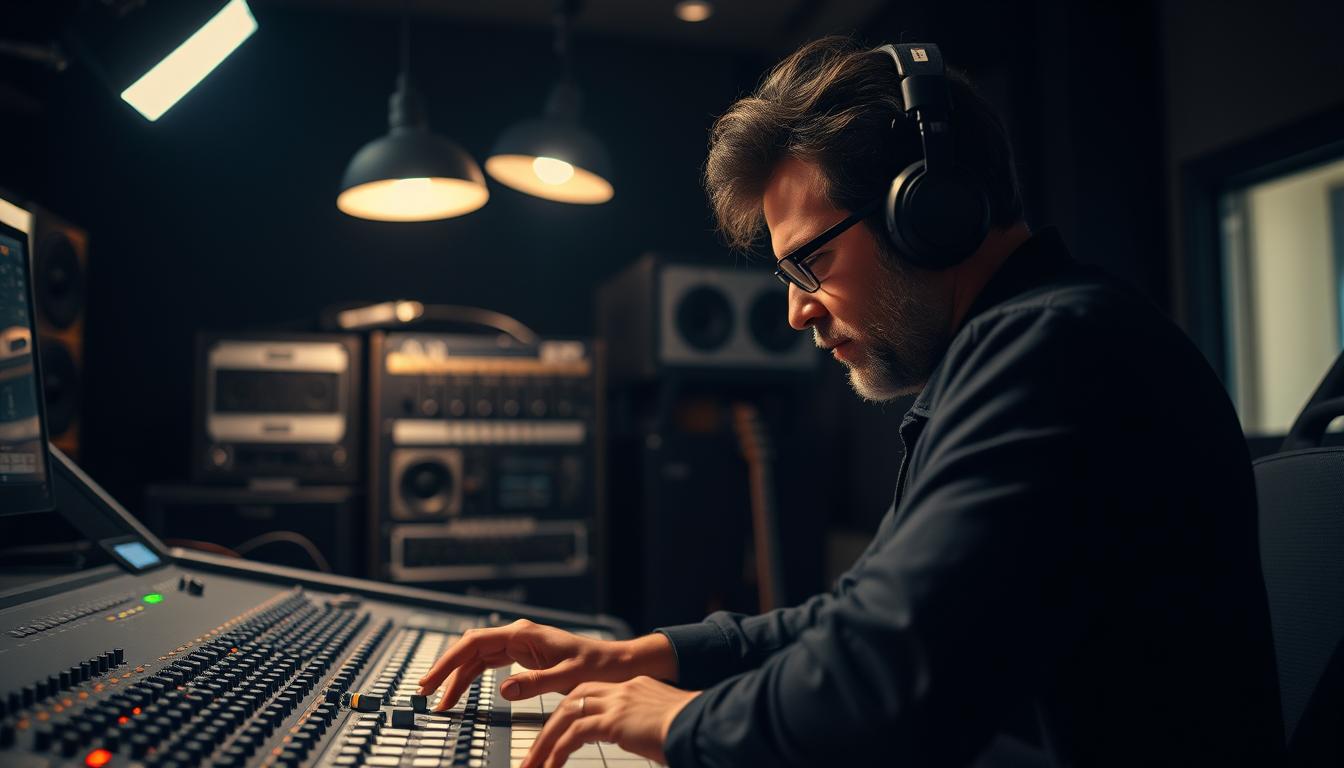
Most people who want to become music producers already know what the role looks like from the outside. They’ve watched studio footage, followed producers on social media, seen the credits on albums they love.
What they’re less clear on is the actual path — the specific skills to build, the decisions that shape a career early, the differences between what the internet says and what the work actually involves.
This guide cuts through the noise. It covers what a music producer actually does, the skills that matter most, how to build a practice without overspending on gear, and what the business side of the career looks like once the music is made.
What a Music Producer Actually Does
The title gets applied loosely, so it helps to start with what production work genuinely involves.
A music producer shapes the sound and direction of a recording. That means making decisions about the arrangement, the performance, the sonic texture, and how all of those elements fit together into something that works for a listener.
In practice, it looks like choosing which take to keep, deciding where the bass needs to sit in a mix, restructuring a verse because the momentum drops, or pushing a vocalist to try something they weren’t planning to try.
The role sits at the intersection of creative direction and technical execution. Some producers lean further toward the creative side — they develop an artist’s vision, manage the emotional arc of a session, and hand off the technical finishing to engineers.
Others handle everything from tracking to mastering. Most operate somewhere in between, which means the job description genuinely varies depending on the project, the artist, and the budget.
Three producer types come up most consistently in professional contexts.
Creative producers focus on the artistic decisions: song selection, arrangement, performance coaching, sonic identity. They may not touch the technical controls but leave a clear fingerprint on the final product.
Technical producers work primarily in the recording and mixing process. They understand signal flow, acoustic treatment, plugin chains, and how decisions made at tracking affect what’s possible at mix.
Executive producers manage the project at the business level — budget, timeline, coordination between sessions, delivery to the label or client. This role shows up more in larger commercial projects.
Most independent producers starting out will wear all three hats, which is actually an advantage. Knowing every part of the process makes you a better collaborator and a more effective decision-maker when you eventually delegate.
The Skills That Actually Drive Progress
Music production rewards a specific combination of skills. Not all of them get equal attention in how-to content, which is worth addressing directly.
Music Theory and Ear Training
You don’t need a conservatory education to produce well, but you need a functional understanding of how music is constructed.
Knowing how chords relate to each other, how rhythm creates tension and release, how a melody sits against a harmonic bed — these give you language for the decisions you’re making and vocabulary for communicating with collaborators.
Ear training matters as much as theory, possibly more. The ability to hear what’s wrong with a mix, identify why a chord progression isn’t landing, or recognize a pitch issue before it becomes a problem in post — these skills develop through listening as much as studying.
Spend time actively listening to music you want to make. Pull apart the production choices. Ask why they work.
DAW Proficiency
Your digital audio workstation is the central tool of the work. Choosing one is less important than committing to learning one thoroughly.
Ableton Live is the dominant choice for electronic, hip-hop, and live performance contexts. Logic Pro is strong for recording-focused work and has a comprehensive suite of built-in instruments and effects.
FL Studio has a large community among beatmakers and hip-hop producers and has a workflow some people find significantly more intuitive for pattern-based composition.
Whichever you choose, the goal is to stop thinking about the software and start thinking through it. That level of fluency comes from using it daily for months before you’ve made anything you’re proud of.
Mixing and Sound Design
Mixing is about balance and clarity — getting each element to sit in its own space so the listener can hear the whole picture without anything fighting for attention.
The core tools are EQ, compression, reverb, and delay. Understanding what each one does technically, and more importantly why you’d reach for it in a given moment, takes sustained practice.
Sound design is about creating and sculpting audio from the source — building your own sounds using synthesizers rather than relying entirely on presets.
This is where producers often develop their most recognizable character. The producers who are distinctive usually have a specific approach to sound that makes their work immediately identifiable.
Communication and Collaboration
Production is collaborative work. Even producers who work primarily solo eventually work with artists, and the ability to communicate clearly — to give direction without being directive, to receive feedback without getting defensive, to understand what an artist is trying to say even when they don’t have the vocabulary to say it precisely — is a real professional skill. It’s also one that’s consistently underweighted in how production is taught.
Building a Home Studio That’s Actually Functional
You don’t need a professional studio to start. The producers whose work defines entire eras — Timbaland, Metro Boomin, Madlib — built their foundational skills in bedrooms and home setups. What you need is a setup that’s functional enough to execute ideas without the limitations fighting you.
The Essential Chain
Computer: The most important variable is processing power, specifically RAM and CPU. Music production software is demanding. 16GB of RAM is a reasonable starting point for most DAWs. Don’t prioritize storage size over processing speed.
DAW: Most come with a free trial. Use it seriously before committing. Logic Pro is only available on Mac and is a one-time purchase. Ableton and FL Studio both offer tiered pricing. Reaper is significantly cheaper than most alternatives and is used by professionals.
Audio interface: This converts the analog signal from a microphone or instrument into digital audio your computer can work with. The Focusrite Scarlett series is the most commonly recommended entry point — the 2i2 handles most recording needs for a single producer. Don’t record vocals or instruments directly into your computer’s built-in sound card.
Headphones and monitors: Headphones first. The AKG K240 and the Sony MDR-7506 are both professional reference headphones available for under $150. Studio monitors come later, when you’re in a space that’s acoustically treated enough to make them useful — an untreated room will mislead your mixing decisions in ways headphones won’t.
Microphone: A large-diaphragm condenser like the Audio-Technica AT2020 is a reliable starting point for vocals. If you’re recording instruments in a live space, a dynamic mic like the Shure SM57 is more versatile and more forgiving of room acoustics.
What to Skip Early
A large MIDI keyboard, outboard hardware, high-end monitors, acoustic treatment panels — these improve a functional studio but don’t create one. Build the skills on the setup you have. Upgrade when the limitations of the gear are genuinely the constraint, not your fluency.
Learning Production: What Actually Works
The path is more important than the format. People become skilled producers through formal programs, self-teaching, apprenticeships, and everything in between. What the successful ones have in common is not the route they took but the practice habits they built along the way.
Formal Education
Degree programs in music production and audio engineering give you structure, equipment access, and peer community. They also take time and money. If you’re considering a formal program, the most important question is what the working alumni look like — what are they actually doing, and does that match where you want to go?
Audio engineering programs are generally more technically rigorous and more immediately vocational than broader music production degrees. If your interest is in the recording and mixing side, an engineering program may be a better fit.
Self-Teaching
Most working producers today are largely or entirely self-taught. YouTube has become a genuinely useful production education resource.
Channels focused on specific software (there are strong communities around every major DAW) provide tutorials that rival formal instruction for technical content.
The limitation of self-teaching is the absence of feedback. You can watch a mixing tutorial and then make the same errors for months without realizing it because no one is hearing your work critically. Build feedback mechanisms into your self-teaching — find a community, share work regularly, and get honest responses.
Mentorship
Working closely with an experienced producer accelerates learning in ways that formal study and self-teaching don’t replicate.
The knowledge that comes from watching someone make decisions in real time — why they chose that plugin over another, how they handled a difficult moment in a session, what they did when the arrangement wasn’t working — is qualitatively different from what you can get from a tutorial.
If you can find a way into a working relationship with a more experienced producer, even as an unpaid assistant, the practical education is usually worth more than the cost.
The Production Process, Step by Step
Knowing the stages gives you a map for where you are in a project and what decisions matter at each point.
Pre-production is the work before recording starts. It involves choosing the songs, working out the arrangements, identifying the sonic direction, and solving as many problems in advance as possible. Time spent in pre-production saves twice the time in production.
Recording is capturing the performance. The goal is to get the highest-quality source material you can — problems recorded in are harder to solve in mixing than people expect.
Editing involves cleaning up the recorded material: comping takes, timing corrections, pitch adjustments. How much editing a track needs depends on the performance and the genre. Some music is better with the imperfections intact.
Mixing is balancing the elements so the whole picture is clear and intentional. This is where EQ, compression, reverb, and spatial decisions happen.
Mastering is the final step before distribution — adjusting the overall level, tonal balance, and loudness for consistency across playback systems and streaming platforms.
For gospel and Christian music specifically, understanding your distribution endpoint matters at the mastering stage. Spotify, Apple Music, Boomplay, and YouTube all have different loudness normalization standards. A master that sounds punchy on one platform can sound distorted on another.
Developing Your Own Sound
This question comes up constantly and has fewer clear answers than the technical questions. What’s true is that a distinctive sound develops through accumulation, not through planning.
The producers who are immediately recognizable built their identity by going deep on specific influences, specific tools, specific approaches to texture and rhythm.
Metro Boomin’s association with dark, orchestral trap production didn’t come from deciding to make dark orchestral trap. It came from years of working obsessively in a specific direction.
The practical implication is to follow what you’re genuinely drawn to rather than what’s currently trending. Work in the style you love most even when that style isn’t commercially dominant.
The producers who chase trends usually end up a step behind; the ones who develop a clear identity in a specific lane eventually get called for exactly that identity.
Building a Portfolio and Finding Clients
Your portfolio is how you get work before you have a reputation. It needs to demonstrate range within your focus area, technical quality, and a sense of your own voice.
Start with personal projects — beats, instrumentals, full productions featuring artists you know or work with independently.
Post consistently on platforms where your work can be heard. SoundCloud, YouTube, and Audiomack are the primary ones, with Audiomack particularly strong in African music markets.
First clients often come through proximity: artists in your city, musicians you know personally, collaborators from online communities.
The ability to listen well, meet deadlines, and execute at a consistent technical level is what keeps those relationships active and generates referrals.
Set rates that reflect your experience level honestly. An early-career producer charging like an established one prices themselves out of the market; one who undercharges so aggressively that the work isn’t sustainable won’t last long enough to build the portfolio that warrants higher fees. Research what producers at your experience level are charging in your market and start there.
The Business of Music Production
Most of what’s written about music production focuses on the creative and technical dimensions. The business side is where careers either compound or stall.
Rights and Royalties
When you produce a song, you’re typically creating a composition (the underlying musical work) and, if you also record it, a master recording.
These generate different types of royalties. Understanding what you’re creating and what rights are attached to it should happen before a project is released, not after.
If you produce a beat that an artist records over, you need a clear agreement about ownership, royalty splits, and how the song can be used.
A simple producer agreement doesn’t have to be complicated, but it needs to exist. In Nigeria, the Copyright Act governs music rights; registration with the Nigerian Copyright Commission provides formal protection. In the US and UK, registration with the Copyright Office (US) or automatic protection at creation (UK) applies. The specific mechanisms differ — know which jurisdiction applies to your work.
Mechanical royalties (paid when a song is reproduced), performance royalties (paid when a song is played publicly), and neighboring rights (paid to recording rights holders for public performance of the master) are the three primary royalty streams a producer can participate in. Collection societies handle the administration: COSON and MCSN in Nigeria, ASCAP and BMI in the US, PRS and PPL in the UK.
Marketing Your Work
Your production work needs to be findable. A simple website with audio samples, a clear description of what you do and who you work with, and a contact form is more effective than the absence of one. Social media is useful for staying visible between projects — short clips of session work, sound design process, finished tracks.
The most effective marketing for producers is ultimately the music itself. Work that gets placed — that ends up on albums, in sync placements, on editorial playlists — generates more opportunities than any direct promotion. Building a body of work you’re proud of is the marketing strategy that compounds.
Common Challenges and What to Do About Them
Creative blocks are universal and not a sign that something is wrong with your process. The most reliable fix is to change the context. Work on a different genre, start from a constraint you wouldn’t normally set, or collaborate with someone whose instincts differ from yours. Taking a break and coming back with fresh ears solves more problems than pushing through does.
Difficult clients are mostly a communication problem. Clear agreements before a project starts — what’s included, how many revisions, what the timeline is — reduce conflict significantly. When a client is genuinely difficult to work with, it’s worth evaluating whether the fee justifies the energy before accepting the next project.
Staying current doesn’t mean chasing every new sound. It means understanding what’s working in the market and why. Regular listening across genres and markets, attending events when possible, and staying connected to the communities where your work lives are more useful than trying to track every trend.
The gap between your taste and your current output is a real and frustrating phase that most producers go through. Ira Glass described it clearly: your taste develops faster than your ability. The gap closes through volume — more production, more feedback, more deliberate practice. There’s no shortcut, but knowing the gap is normal makes it easier to work through.
FAQs
Do I need a music degree to become a music producer?
No. A degree provides structure, equipment access, and community, but the music production industry doesn’t credential in that way. What it evaluates is the work. Build a portfolio that demonstrates your skills and your voice, and it matters significantly more than any credential.
How long does it take to become a music producer?
There’s no fixed timeline, and anyone who gives you one is estimating. Functional competence in your DAW and core production skills develops over months to a couple of years of consistent daily practice. Building a career — generating income from the work consistently — typically takes several years, depending on how aggressively you build your network and how quickly your work improves.
What’s the difference between a music producer and a beat maker?
A beat maker creates the instrumental backing for a track, typically working alone. A music producer manages the entire creative and technical production of a recording, which usually involves working with artists, making arrangement decisions, and taking responsibility for the final sound of a finished song. In practice, many producers do both. The distinction is more about scope than skill level.
How do I know when my work is ready to share?
When you can listen to it critically rather than just hopefully. The early instinct is to share as soon as something feels exciting. The better approach is to let it sit for a day, come back with fresh ears, fix what you notice, and then share. Work that’s been through that cycle is usually significantly stronger than work shared in the moment of making it.
Where to Go From Here
The fundamentals covered here — understanding the role, building the skills, setting up a functional home studio, navigating the business — give you the foundation. The next step is doing the work rather than reading about it.
Open your DAW. Make something. Listen critically. Make something better. That process, repeated consistently over time, is what the career is built on.