


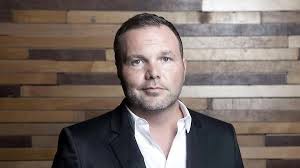
Mark A. Driscoll (born October 11, 1970) is an American evangelical pastor and author who co-founded Mars Hill Church in Seattle, Washington, in 1996 and built it into one of the largest, most talked-about megachurches in the country before resigning in 2014 amid charges of bullying and domineering leadership.
He now leads Trinity Church in Scottsdale, Arizona, which he founded in 2016. Few pastors in modern American history have generated as much praise and as much controversy from the exact same set of qualities: a blunt, confrontational preaching style that built an empire and then helped tear it down.
Mark Driscoll at a Glance
| Personal | |
|---|---|
| Full Name | Mark A. Driscoll |
| Born | October 11, 1970, Grand Forks, North Dakota, USA |
| Age | 55 (as of 2026) |
| Nationality | American |
| Spouse | Grace Driscoll (née Martin), married in the early 1990s |
| Children | Five: Ashley, Zac, Alexie, Calvin, and one more, three sons and two daughters |
| Parents | Father was a union drywaller; raised Roman Catholic in SeaTac, Washington |
| Education | |
| High School | Highline High School, Burien, Washington (1989) |
| University | Washington State University, B.A. in Communication |
| Seminary | Western Seminary, Portland, Oregon, M.A. in Exegetical Theology |
| Ministry | |
| Title | Senior and Founding Pastor |
| Church | Trinity Church, Scottsdale, Arizona |
| Denomination | Reformed evangelical, non-denominational |
| Since | 2016 (Trinity Church); 1996 to 2014 (Mars Hill Church) |
| Career | |
| Books | 20+, including Real Marriage and Win Your War |
| Net Worth | Estimates vary widely and are unverified, generally cited between $2 million and $5 million |
Early Life and Family Background
Mark Driscoll was born October 11, 1970, in Grand Forks, North Dakota, the oldest of five children. His family moved to the Riverton Heights area of SeaTac, Washington, partly, he’s said, to put distance between themselves and difficult relatives back in North Dakota.
He’s described that side of the family bluntly, writing about alcoholism, mental illness, and domestic abuse running through it.
His father worked as a union drywaller, and the family raised Mark Catholic, though he later described his faith at that point as more cultural than personal.
He attended Highline High School in Burien, Washington, where he was student body president, captain of the baseball team, editor of the school newspaper, and voted most likely to succeed in his graduating class.
It was in high school that he met Grace Martin, the woman who’d become his wife. Grace was the daughter of an evangelical pastor, Gib Martin, which put her on a different spiritual track than Mark from the start.
Conversion and Calling
Driscoll’s faith shifted from cultural Catholicism to evangelical Christianity at age 19, during his freshman year at Washington State University.
He’s described the moment as a direct call. In his own account, God told him to marry Grace, preach the Bible, train men, and plant churches, and from that point forward he organized his life around that instruction with a kind of single-mindedness that would define his ministry style for decades.
He earned a Bachelor of Arts in communication from Washington State University with a minor in philosophy, then went on to a Master of Arts in exegetical theology from Western Seminary in Portland, Oregon.
Mark and Grace married in the early 1990s, not long after his conversion, putting the marriage-and-ministry plan he’d described into motion almost immediately.
Founding Mars Hill Church
After graduating, Mark and Grace moved to Seattle and began volunteering with the college ministry at Antioch Bible Church.
Mark was hired as an intern within months, and through that role he met Mike Gunn, who worked with Athletes in Action at the University of Washington, and Lief Moi, a local radio host.
The three started talking about planting an “urban, postmodern” church aimed at reaching young, unchurched Seattle.
That conversation became Mars Hill Church, founded in 1996 when Driscoll was just 25 years old. The church started small, meeting in the Driscoll family’s living room while Mark and Grace both worked other jobs.
It did not stay small. By March 2014, Mars Hill had grown to roughly 14,000 weekly attendees across 15 locations in five states, with sermon downloads numbering in the millions.
Part of what fueled that growth was Driscoll’s preaching style itself: aggressive, profane at times, and aimed squarely at young men who’d never set foot in a traditional church and had no intention of starting.
Author Donald Miller referenced him in Blue Like Jazz as the “cussing pastor,” a nickname that stuck because it was accurate.
Building a Movement: Acts 29 and The Resurgence
Driscoll’s ambitions reached beyond his own church almost immediately. In 1998, he co-founded the Acts 29 Network with David Nicholas, a church-planting organization built around Reformed theology and an aggressive model for starting new congregations.
Acts 29 grew from 11 founding churches to more than 400 by 2011, including dozens overseas, and Driscoll served as its president until stepping down in March 2012.
In 2006, he launched The Resurgence, a theological cooperative meant to train pastors and church leaders in conservative Reformed doctrine, which functioned alongside Acts 29 and Mars Hill as a kind of media and teaching arm.
He was also a founding member of The Gospel Coalition, a network of Reformed evangelical churches and leaders, though he stepped down from its council the same month he left Acts 29.
Books and Public Profile
Driscoll became one of the most quoted and downloaded pastors in the country, writing more than 20 books over his career. Confessions of a Reformission Rev. told the early Mars Hill story with characteristic bluntness.
Vintage Jesus and Doctrine, co-written with Gerry Breshears, laid out his core theological convictions in plain, direct language built for readers who’d never opened a systematic theology textbook.
His highest-profile book was Real Marriage: The Truth About Sex, Friendship, and Life Together, co-written with Grace and published in January 2012.
The book tackled marriage and sex in graphic, specific terms that drew criticism from across the theological spectrum, with some readers praising its candor and others calling it degrading.
It reached number one on the New York Times Advice bestseller list, a milestone that would later become a serious problem rather than an accomplishment.
Media Appearances and Public Debates
Driscoll’s combative style made him a frequent guest on national media well outside the Christian press. He debated Deepak Chopra on ABC’s Nightline, discussed marriage with Barbara Walters on The View, sparred with Piers Morgan and D.L. Hughley on CNN, and made multiple appearances on Fox News and other outlets.
Preaching Magazine later named him one of the 25 most influential pastors of the previous quarter century, a recognition that captured how far his reach extended beyond Seattle.
The Plagiarism and Bestseller Controversies
The first major crack in Driscoll’s public reputation came in November 2013, when Christian radio host Janet Mefferd accused him on air of using material from theologian Peter Jones in his book A Call to Resurgence without proper citation.
Mefferd later apologized for how she raised the issue but didn’t retract the substance of it, and subsequent reporting found citation problems in several more of Driscoll’s books. His publisher at the time, Tyndale House, initially defended his citations but the controversy continued to follow him.
A bigger problem surfaced in March 2014, when World Magazine revealed that Mars Hill Church had paid a marketing firm called ResultSource roughly $200,000 to $210,000 to manipulate Real Marriage onto the New York Times bestseller list, through a coordinated bulk-purchase scheme.
Mars Hill initially defended the arrangement as a normal marketing investment. Driscoll later called the decision unwise and asked his publisher to remove “New York Times bestseller” from future editions and promotional material.
Why Mark Driscoll Resigned from Mars Hill
The plagiarism and bestseller controversies opened the door to a much bigger reckoning over Driscoll’s leadership style. Over the following months, 21 former Mars Hill elders filed formal complaints describing a pattern of domineering, fear-based leadership.
Specific allegations included harsh language toward staff, public shunning of dissenting members, and a governance restructuring that consolidated power around Driscoll and a small circle of executive elders.
In August 2014, the Acts 29 Network, the organization Driscoll himself had helped found, removed both him and Mars Hill Church from membership.
The following week, dozens of protesters picketed the Bellevue campus where Driscoll preached, carrying signs accusing him of bullying and a lack of financial transparency.
Driscoll stepped back from public ministry for six weeks while Mars Hill’s board of overseers investigated the charges.
The board’s investigation concluded that Driscoll had, at times, been guilty of arrogance, a quick temper, harsh speech, and domineering leadership, while finding no charges of criminal activity, immorality, or heresy.
A restoration plan was drawn up, calling for Driscoll to repent and seek reconciliation with those he’d hurt. He resigned on October 14, 2014, before that plan could be carried out.
“I readily acknowledge I am an imperfect messenger of the gospel of Jesus Christ. Specifically, I have confessed to past pride, anger and a domineering spirit.” — Mark Driscoll, resignation letter, October 14, 2014
Mars Hill’s board of overseers said they were surprised by the resignation and hadn’t asked for it. Within three months, the church dissolved entirely, with its remaining campuses either closing or becoming independent congregations.
Founding Trinity Church in Scottsdale
After leaving Seattle, Driscoll and his family relocated to the Phoenix area. He rebranded his personal ministry nonprofit as RealFaith and, in February 2016, opened Trinity Church in Scottsdale, Arizona, in a distinctive circular building that had originally been constructed in the 1960s as a drive-in church.
Grace and the couple’s five children were involved from the start, making it, by Driscoll’s own description, a family ministry from day one.
Trinity grew steadily through Driscoll’s continued media presence and writing output, and he has remained its senior and founding pastor since.
It’s a smaller operation than Mars Hill ever was, but it gave Driscoll a platform to keep preaching, writing, and building an audience, largely online, that has at points rivaled the reach he had in Seattle.
Renewed Controversy at Trinity Church
Driscoll’s time in Scottsdale has not been free of the patterns that ended his tenure at Mars Hill. In July 2021, more than 40 former Mars Hill elders published a joint statement, addressed to Christianity Today, saying they believed Driscoll remained unrepentant and unfit to serve as a pastor.
The statement pointed to what they described as similar warning signs surfacing at Trinity, including reports from former members about broken relationships within families and people being barred from church property.
In the years since, additional former Trinity members and staff, including a former director of security, have publicly described internal practices like loyalty grading among congregants and strained or severed family relationships tied to departures from the church.
Trinity Church has disputed these characterizations, calling some specific claims false. As with the original Mars Hill complaints, the central tension running through these accounts isn’t doctrine. It’s leadership style and how dissent gets handled inside the church.
Mark Driscoll’s Political Turn
In recent years, Driscoll has built a closer public relationship with conservative political organizing, particularly through Turning Point USA and its religious arm, TPUSA Faith. He appeared on The Charlie Kirk Show starting in 2023 and became a regular guest discussing faith, masculinity, and culture, describing himself as a defender of the faith within that circle.
That association brought its own friction. At an April 2024 men’s conference in Springfield, Missouri, Driscoll criticized a performer’s act on stage in terms the host pastor later called inappropriate, and was asked to leave the stage; the host publicly apologized to his congregation for inviting him.
Driscoll has remained a visible figure in conservative Christian media circles since, including continued appearances tied to Turning Point USA following Charlie Kirk’s death in September 2025.
Family Life
Mark and Grace Driscoll have five children: three sons and two daughters, including their oldest daughter Ashley, who has worked alongside her parents at RealFaith Ministries.
The family has positioned Trinity Church and its associated media projects as multi-generational efforts from the beginning, with the Driscoll children involved in planting and running the church rather than standing at arm’s length from their father’s public ministry.
Grace Driscoll has co-authored several books with Mark, most notably Real Marriage, and has maintained a public role discussing marriage and family alongside him through RealFaith’s “Dear Grace” video series and related content.
Theology and Ministry Philosophy
Driscoll identifies as a Reformed evangelical, holding to Calvinist convictions on salvation, including total depravity and God’s sovereign election, while also affirming continuationist views on spiritual gifts, a combination he has described as “new Calvinism.”
He draws heavily on historical Reformed figures like John Calvin, Jonathan Edwards, and Charles Spurgeon, alongside more contemporary influences like John Piper and Tim Keller, with whom he shared platforms during the Acts 29 and Gospel Coalition years.
His theological convictions are conservative across the board, including a complementarian view of gender roles in marriage and ministry and a traditional biblical view of sexuality and marriage.
What’s set Driscoll apart from many peers holding similar theological positions has rarely been the doctrine itself. It’s been the delivery, blunt, frequently crude, and built to provoke a reaction rather than ease into one.
Influence and Legacy
Driscoll’s influence on early-2000s evangelicalism is hard to overstate, even accounting for everything that came after. Mars Hill helped popularize an entire model of culturally engaged, internet-savvy church planting that influenced a generation of pastors well beyond Acts 29’s own network.
Timothy Keller, the late pastor of Redeemer Presbyterian in New York, said Driscoll had built up the broader evangelical movement enormously in the internet age, even while acknowledging the personal conduct that eventually disillusioned many who’d followed him.
The 2021 Christianity Today podcast The Rise and Fall of Mars Hill brought Driscoll’s story to a new audience years after the church’s collapse, reframing the conversation around questions of accountability and power in megachurch leadership that have outlasted Mars Hill itself.
Whatever else gets said about Driscoll’s specific theology or style, the Mars Hill story has become one of the standard case studies cited whenever evangelical institutions discuss what unchecked pastoral authority can produce.
Criticism and Controversies
The major controversies of Driscoll’s career are well documented and worth stating plainly rather than softening. They include the 2013 to 2014 plagiarism allegations across multiple books, the 2014 revelation that Mars Hill Church funds were used to manipulate his book onto the New York Times bestseller list, and the formal elder complaints describing a domineering, fear-driven leadership culture that led directly to his resignation.
Since 2021, some of the same patterns have resurfaced in accounts from former Trinity Church members, and more than 40 former Mars Hill elders have publicly stated they don’t believe Driscoll has adequately reckoned with the conduct that ended his time in Seattle.
Driscoll has acknowledged past sins of pride, anger, and a domineering spirit in his resignation letter and elsewhere, while maintaining he was never charged with immorality, criminal activity, or heresy.
Net Worth and Financial Information
Public estimates of Mark Driscoll’s net worth vary considerably and are not independently verified, typically ranging from around $2 million to $5 million.
These figures come from celebrity-finance tracking sites rather than any official disclosure from Driscoll, Trinity Church, or RealFaith Ministries, so they should be read as rough public estimates rather than confirmed fact. His income has historically come from book royalties, speaking fees, and his pastoral role.
Interesting Facts About Mark Driscoll
- He planted Mars Hill Church in his own living room at age 25, while he and Grace both worked other jobs to support themselves.
- Author Donald Miller’s bestselling memoir Blue Like Jazz referred to him as the “cussing pastor” years before that became a defining part of his public image.
- Mars Hill Church spent roughly $200,000 to manipulate Real Marriage onto the New York Times bestseller list, a scheme Driscoll later called unwise.
- He co-founded the Acts 29 church-planting network with the explicit goal of starting 1,000 new churches; it had grown to more than 400 by 2011.
- His oldest daughter, Ashley, helped start RealFaith Ministries alongside her parents and remains involved in the family’s media work.
Timeline
| Year | Milestone |
|---|---|
| 1970 | Born October 11 in Grand Forks, North Dakota |
| 1989 | Graduates Highline High School in Burien, Washington |
| 1989 | Converts to evangelical Christianity at age 19 as a college freshman |
| Early 1990s | Marries Grace Martin |
| 1996 | Co-founds Mars Hill Church in Seattle, Washington, at age 25 |
| 1998 | Co-founds the Acts 29 church-planting network |
| 2006 | Launches The Resurgence theological cooperative |
| 2012 | Real Marriage reaches No. 1 on the NYT Advice bestseller list; steps down as Acts 29 president |
| 2014 | Resigns from Mars Hill Church on October 14 amid elder investigation; Mars Hill dissolves within months |
| 2016 | Founds Trinity Church in Scottsdale, Arizona |
| 2021 | Subject of Christianity Today’s “The Rise and Fall of Mars Hill” podcast; 40+ former Mars Hill elders publicly call for his resignation from ministry |
| 2023 | Begins regular appearances on The Charlie Kirk Show and with Turning Point USA Faith |
Frequently Asked Questions
Did Mark Driscoll ever apologize?
Yes. In his October 2014 resignation letter, Driscoll confessed to past pride, anger, and a domineering spirit, and he has offered apologies at various points for plagiarism issues and crude comments. Whether those apologies amount to the kind of accountability his critics are asking for remains a point of ongoing disagreement among former Mars Hill leaders.
Why did Mark Driscoll resign?
Driscoll resigned from Mars Hill Church in October 2014 after a formal elder investigation concluded he had been guilty of arrogance, quick temper, harsh speech, and domineering leadership. The investigation followed plagiarism allegations and the revelation that the church had paid to manipulate his book onto a bestseller list.
Where does Mark Driscoll pastor now?
Driscoll is the senior and founding pastor of Trinity Church in Scottsdale, Arizona, which he established in 2016, two years after leaving Mars Hill.
What is Mark Driscoll’s net worth?
Public estimates place his net worth somewhere between $2 million and $5 million, though these figures are not independently verified and come from unofficial sources rather than any financial disclosure.
Is Mark Driscoll still married?
Yes. Mark and Grace Driscoll have been married since the early 1990s and have five children together.
Is Mark Driscoll still a pastor?
Yes. He continues to serve as senior and founding pastor of Trinity Church in Scottsdale, Arizona.
What church did Mark Driscoll start?
He co-founded Mars Hill Church in Seattle in 1996, which grew to roughly 14,000 members across 15 locations before dissolving in late 2014 following his resignation.
What denomination is Mark Driscoll?
Driscoll identifies as a Reformed evangelical, holding Calvinist convictions on salvation alongside continuationist views on spiritual gifts. Both Mars Hill and Trinity Church have operated as non-denominational congregations rather than belonging to a formal denomination.
Read Also
- Rich Wilkerson Sr. biography
- Joby Martin Biography
- Louie Giglio Biography
- Samuel Rodriguez Biography
- John Bevere Biography